Every serious athlete knows the scoreboard is the wrong place to learn how you handle pressure. You learn that in training, with a clock running and a coach pointing out what went wrong. Professional certification study works the same way. If you are preparing for the ICAgile Certified Professional (ICP) track, the habits that separate steady progress from last-minute panic look a lot like a good training block.
This guide borrows from sports preparation to show how timed mock tests and careful review of explanations can sharpen your agile knowledge.

A confident professional beside a team planning at a whiteboard, with a certificate graphic for the ICAgile Certified Professional course
Start with what ICAgile actually says
Before you build any study plan, check what the certifying body asks of you. On its Agile Fundamentals page, ICAgile points candidates to its list of accredited classes, and says its training providers offer remote and self-paced courses. The featured learning outcomes include the history of agile and cultivating an agile mindset, value-driven development, including customers and users in the development process, and process and product adaptation. A full list sits in a downloadable learning outcomes document.
Two other details matter. The page does not describe a standalone exam format, so the assessment method is something to confirm with your chosen training provider. And according to ICAgile, once you earn a certification it is yours for life, with no renewal fees.
That means practice questions are a study aid, not a substitute for the accredited class. Think of them as the extra conditioning you do alongside team practice. They help you notice gaps, but they do not replace the coach, the drills or the real match.
Why timed mock tests work like scrimmages
A scrimmage is not the game, but it recreates enough of the game's tension to expose weaknesses that drills never reveal. A timed mock test does the same for knowledge work.
When you answer questions at your own pace with your notes open, you mostly measure how well you can look things up. When you answer under a clock, you measure what you can recall and apply. That difference is exactly what you want to find out while there is still time to fix it.
Be Ready Education's ICAgile Certified Professional practice tests on Udemy are built around this idea. The course contains five timed practice tests with 60 questions each, which makes 300 questions in total. Every question comes with an explanation. It is an independent practice set from Be Ready Education, not affiliated with or endorsed by ICAgile.
Here is a simple way to use the five tests across a training block:
1. Test one as a baseline. Take it cold, under the clock, before you feel ready. A low score here is information, not failure.
2. Tests two and three after focused study. Spend a few days on the topics you missed, then retest.
3. Test four as a dress rehearsal. Sit it in one block, in a quiet room, with no pausing.
4. Test five as a final check. Use it a few days before your accredited class assessment or whenever you want a last read on your readiness.
Spacing the tests out matters. Five tests in one weekend is cramming. Five tests across two or three weeks is training.
Review is where the gains happen
Elite coaches spend more time on game film than on the game itself. The same principle applies here. Finishing a mock test is only half the session. The other half is review, and for most people it is the half that produces the improvement.
Because every question in the course has an explanation, you can turn each test into a feedback loop. A practical review routine looks like this:
- Sort every miss into a cause. Was it a knowledge gap, a misread question, or a rushed guess? Each cause needs a different fix.
- Read the explanation even when you got it right. A correct answer reached by luck is a hidden weakness. If your reasoning does not match the explanation, treat it as a miss.
- Write one sentence per mistake. State the principle in your own words, for example how a team involves users earlier to reduce wasted work. If you cannot write the sentence, you have not learned it yet.
- Keep an error log. After two or three tests, patterns appear. Maybe you consistently confuse process adaptation with product adaptation, or you rush through questions about customer involvement.
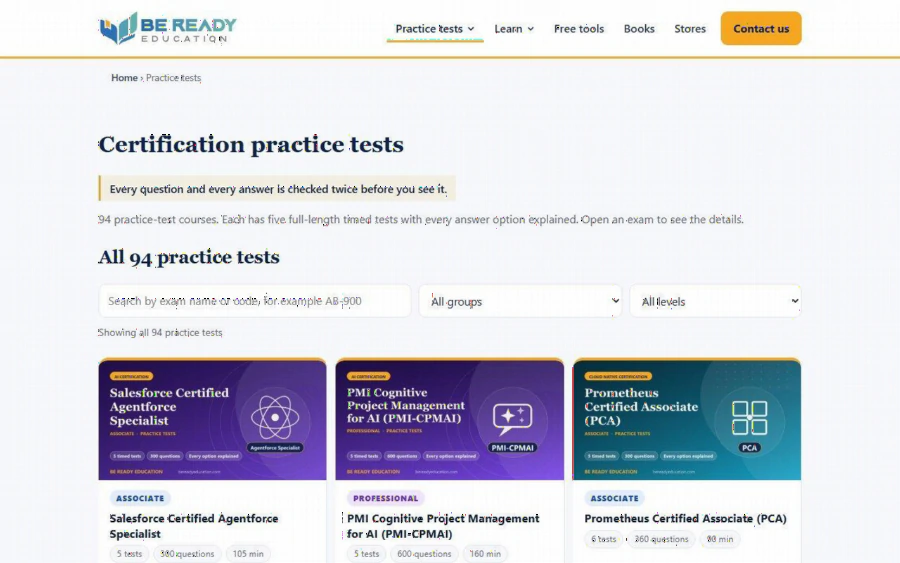
The Be Ready Education certification practice tests page, listing practice-test courses with five timed tests each
Build the mindset, not just the answers
ICAgile certification is about demonstrating knowledge, skills and an agile mindset, not just reciting definitions. That is worth remembering when you review. Many agile questions describe a team situation and ask what a thoughtful practitioner would do. The right answer usually reflects a principle, such as delivering value early, listening to customers, or adapting based on feedback.
If you only memorize which option was correct, you may miss the next variation of the same scenario. If you understand why the option fits the mindset, you can handle a question you have never seen.
An athlete analogy helps again. A basketball player does not memorize one play. They learn spacing, timing and reading the defender, so they can respond when the defense changes. In the same way, learn the reasoning behind agile practices so you can apply them when a scenario is phrased differently.
Pace yourself like a distance runner
Time pressure causes more mistakes than most people expect. Sixty questions per test gives you a good sample to practice pacing without making each sitting exhausting.
Try these habits during timed tests:
- Set a checkpoint rhythm. Decide in advance where you want to be at the halfway point, and glance at the clock only then. Checking constantly breaks concentration.
- Skip and return. If a question stalls you, mark it and move on. Burning two minutes on one question is like sprinting the first lap of a long race.
- Read the last line first. Seeing what is being asked before reading a long scenario saves time and reduces misreads.
- Practice calm. Slow breathing for a few seconds before you begin is a small habit that costs nothing and often improves focus.
If you notice that your accuracy drops sharply in the final third of a test, that is a stamina issue, and the fix is more full-length sittings, not more reading.
Recovery and consistency beat intensity
Athletes who train hard every day without rest tend to plateau or get injured. Study works the same way. A sensible weekly rhythm might include two timed sessions, two review sessions and a lighter day for reading the learning outcomes or discussing concepts with colleagues.
Consistency also matters more than session length. Thirty focused minutes of error log review on a weekday often does more than a three hour marathon on Sunday. Keep sessions short enough that you can concentrate fully, and stop when quality drops.
Know the limits of practice questions
Honest preparation means acknowledging what practice tests cannot do. They do not replace an ICAgile accredited class, and they do not replace real experience working in agile teams. Scoring well on a practice set does not guarantee an outcome in your accredited class, and the course does not promise one.
What they can do is help you find weak areas early, get comfortable working under time pressure, and build the habit of reasoning through scenarios. Combine them with the class itself, the official learning outcomes, and real conversations with people who work in agile teams.
If you want to explore other certification practice sets from the same publisher, you can browse the other certification practice courses on the Be Ready Education website. Always check the details of each course before you start.
A simple four week plan
If you like a concrete schedule, this one fits around a busy job:
- Week one: Read the official learning outcomes from ICAgile, attend or review your class material, then take test one under the clock. Start your error log.
- Week two: Study the weakest areas from test one, then take test two. Compare your error log with last week's patterns.
- Week three: Take test three and test four on separate days. Spend double the time on review compared with the time spent testing.
- Week four: Revisit your error log, reread the explanations for questions you missed more than once, and take test five a few days before your assessment.
Adjust the pace to your own calendar. The point is a steady rhythm of practice, review and rest, not a perfect schedule.
Final whistle
Good preparation is rarely dramatic. It looks like showing up, running the drill, watching the film and fixing one thing at a time. Timed mock tests give you the drill, and explanations give you the film. Use them together, stay honest about what they can and cannot do, and keep your focus on understanding the agile mindset rather than chasing a score.
Whether you are new to agile or formalizing years of experience, a steady training block will leave you calmer and better prepared on the day that counts.