Every football fan knows the moment. The cup final kicks off, a few hundred thousand people open the same live-score app at once, and the goal alert arrives a full minute after the stadium roared. Somewhere in a back room, an engineer is staring at a dashboard asking one question: where did the time go? Was it the API gateway, the database, the push notification service, or a slow third party feed?
That question is exactly what OpenTelemetry was built to answer, and it is why more engineers who run match-day systems, ticketing platforms and streaming apps are now looking at the OpenTelemetry Certified Associate credential. If you are one of them, this article looks at a way to prepare: OpenTelemetry Certified Associate (OTCA) practice tests from Be Ready Education. I will cover what the exam tests, what the practice course contains, where it helps, and where it does not.
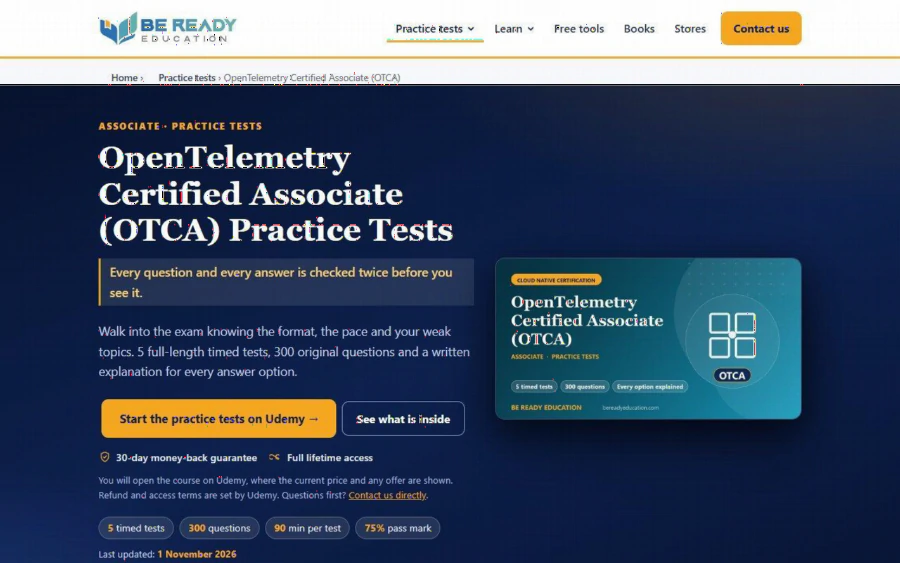
The Be Ready Education page for the OpenTelemetry Certified Associate practice tests, showing 5 timed tests, 300 questions, 90 minutes per test and a 75 percent pass mark
Why a stadium app is a good way to think about OpenTelemetry
Imagine a ticketing service on the night of a big fixture. A fan taps "buy", and that one tap fans out into many calls: an identity check, a seat reservation, a payment provider, an email confirmation. When the purchase takes eight seconds instead of one, logs from each service tell you only a fragment of the story.
OpenTelemetry gives those fragments a shared structure. A trace follows the single purchase across every service it touches. Metrics show the pattern over time, such as request rates and error counts. Logs add the detail at a specific moment. The Collector sits in the middle, receiving data, processing it and sending it on to whichever backend your team uses. According to the exam page on the Be Ready Education site, the certification covers "traces, metrics, logs and the Collector", which matches this picture closely.
The point for a candidate is that the exam is not about memorizing a product. It is about understanding a vocabulary and a set of ideas well enough to reason about a system you have never seen. That is a different kind of studying, and it is where practice questions earn their place.
What the exam looks like
The Be Ready page describes the provider's exam as an online, proctored, multiple-choice test lasting 90 minutes. It also notes that the exam purchase includes two attempts, one of them a retake, with 12 months to take the exam. The page does not list domain weightings or the official pass mark, and it sends readers to the provider's own exam guide for those details. That is the right call, because formats and rules change, and you should always confirm them with the certification provider before you book.
Two practical consequences follow. First, 90 minutes is long enough that pacing matters, but short enough that you cannot afford to dwell on a single question. Second, because the guide is the official source for what is in scope, your study plan should start there, with practice tests used to check how well you actually know that material.
What is inside the practice course
Here is what the product page states, and I am quoting the figures as published on the site:
- 5 full-length timed practice tests, with 300 questions in total, so 60 questions per test.
- 90 minutes per test, which mirrors the length of the exam described above.
- A 75 percent pass mark inside the practice tests.
- A written explanation for every answer option, correct and incorrect.
- A free timer, a pass score calculator, a score tracker, and study plans of two weeks and four weeks.
- A 30-day money-back guarantee and lifetime access, with refund and access terms set by Udemy, where the course is delivered.
The site also says the questions are original and written by Be Ready, and the product is limited to vendor certifications. I have not tried to verify the quality of every question, so treat that as the publisher's claim rather than something I tested. What I can say is that the structure is sensible. Five tests of 60 questions each give you enough volume to see patterns in your mistakes without turning study into a grind.
The price is not stated on the page. The site says the Udemy course shows the current price and any offer, so check there on the day you decide.
The part that actually helps: explanations on every option
Most people think practice tests are for measuring. They are at least as useful for teaching, and that depends on what happens after you answer.
A question about the Collector might ask which component is responsible for turning received data into a different shape before it is exported. If you pick the wrong answer and see only "incorrect", you learn nothing. If you see why the right option is right, and why each of the other three is wrong, you have just reviewed four concepts instead of one. That is the design choice Be Ready highlights, with a written explanation for every option.
For a topic like OpenTelemetry, where several terms sound similar, this matters a great deal. Spans, traces, context and baggage are easy to blur together. So are receivers, processors and exporters. Reading why a close distractor is wrong is often the moment the distinction finally sticks.
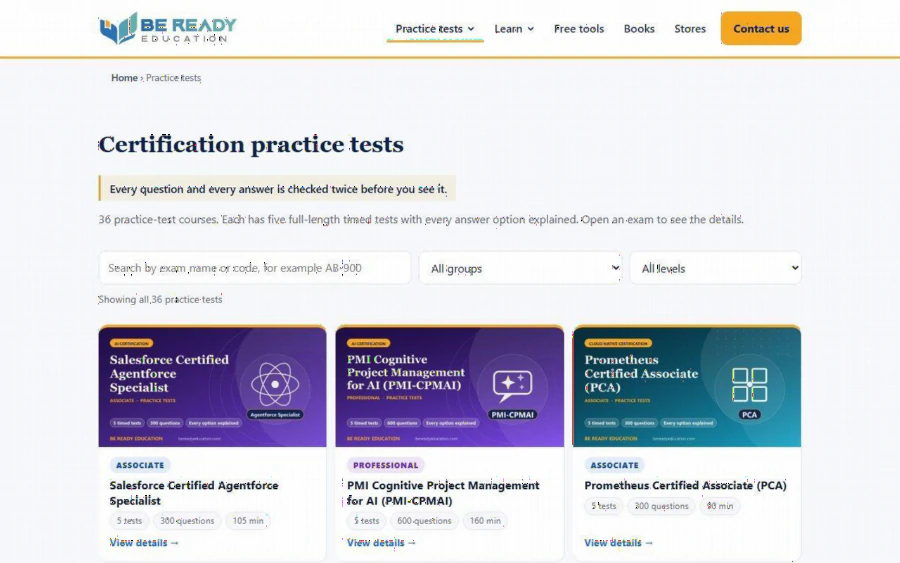
The Be Ready Education practice tests index listing 36 certification practice test courses, each with five timed tests
A study plan that fits a working engineer
If you work in operations or development, you probably have evenings and not whole days. The site offers two week and four week plans, and the choice depends on your starting point.
If you already run OpenTelemetry in production, consider the shorter plan. Take the first test cold, without preparing, to find the gaps. Read the explanations for everything you missed, and for anything you got right but guessed. Then spend your remaining time on the official exam guide topics where you scored lowest.
If you are newer to observability, use the longer plan. Spend the first week with the project's own documentation and a small demo application, so that traces and metrics are something you have seen rather than only read about. Then begin the tests, treating the first one as a diagnostic.
In both cases, the site suggests scoring 85 percent or more on two tests in a row before you book the real thing. That is a cautious benchmark, and a sensible one, but it is a guide and not a promise. A good score on practice material does not guarantee a result on exam day, and nothing on the site claims that it does.
Strengths and limits, stated plainly
Strengths. The format is close to the exam length. Every option is explained. The tools for tracking scores are free. The course is on a platform most people already know, with lifetime access and a refund window. And Be Ready keeps its focus narrow: its index page lists 36 practice test courses, all for vendor certifications, and each is built on the same pattern of five timed tests.
Limits. Practice questions cannot replace hands on time with the tools. If you have never configured a Collector pipeline or instrumented a service, no number of questions will give you the intuition that doing it once will. The page also does not publish domain weightings, so you need the official guide to know how to divide your time. And because the questions are written by a third party, they will not match the exam wording exactly, nor should you want them to. The goal is to understand the ideas, not to recognize a question you saw before.
Who should skip it. If you already hold several cloud native certifications and use OpenTelemetry daily, you may only need the first test as a quick check. If your budget is very tight, the free official material plus a personal demo project can take you a long way, though you will not get the timed practice or the written explanations.
Why the credential is worth the effort
Back to the cup final. The engineer who found the delay did not guess. They followed a trace, saw the push notification service waiting on a slow downstream call, and fixed it before the next match. That skill, reading a system through its telemetry, is what employers in sport, media, retail and finance increasingly want, because the cost of a slow app on a big night is public and immediate.
A certificate does not make you that engineer, but studying for one in a structured way forces you to learn the whole map, including the parts your current job never touches. If your team uses OpenTelemetry for only traces, preparing for the exam will push you through metrics, logs and the Collector as well.
How to get started
1. Read the provider's official exam guide first, and note the domains.
2. Open the OTCA practice tests page and check the format, the figures and the current Udemy price.
3. Pick the two week or four week plan and put the five tests in your calendar, one every few days.
4. Take test one cold. Read every explanation, right or wrong.
5. Build a small instrumented demo so the concepts are no longer abstract.
6. Book the exam when you consistently score above the benchmark, and confirm the current rules with the provider.
If you want to see what else is available before committing, Be Ready Education also keeps an index of its certification practice tests covering AI, cloud, security and agile topics.
The next time a goal alert arrives late, you will know where to look. Good preparation turns that question from a scramble into a routine.